Parisine
Designed by Jean Francois Porchez
Collections
| Collection | Purchase |
|---|---|
| Parisine Full Family 16 fonts
|
|
| Parisine 4 Weights – regular, italic, bold, bold italic
|
Styles
| Style | Purchase |
|---|---|
|
Parisine Clair Regular
|
|
|
Parisine Clair Italic
|
|
|
Parisine Clair Bold Italic
|
|
|
Parisine Clair Bold
|
|
|
Parisine Gris Regular
|
|
|
Parisine Gris Italic
|
|
|
Parisine Regular
|
|
|
Parisine Italic
|
|
|
Parisine Gris Bold
|
|
|
Parisine Gris Bold Italic
|
|
|
Parisine Bold
|
|
|
Parisine Bold Italic
|
|
|
Parisine Sombre Regular
|
|
|
Parisine Sombre Italic
|
|
|
Parisine Sombre Bold Italic
|
|
|
Parisine Sombre Bold
|
Parisine is a workhorse and economical sanserif, highly legible, who can be considered as a more human alternative to the industrial-mechanical Din typeface family. More human, but not fancy: No strange “swashy” f, or cursive v, w etc. on the italics, to keep certain expected regularity, important for information design, signages, and any subjects where legibility, sobriety came first.

Parisine is organised in various subsets, from the original family Parisine (4 compatible fonts), Parisine Gris featuring lighter versions of the usual Regular and Bold (4 compatible fonts), Parisine Claire featuring extra light weights (4 compatible fonts), to Parisine Sombre with his darker and extremly black weights as we can seen in Frutiger Black or Antique Olive Nord (4 compatible fonts). Each member of the family is composed of more than 720 glyphs and feature thousand of kerning pairs. Many years of adjustments were necessary to refine this complex family.
Initially, Parisine was designed by Jean François Porchez in 1996 for Ratp to solely fulfil the unique needs of signage legibility. Parisine remain the official corporate typeface of the public transport in Paris, the worldwide capital for tourism, and now integral part of the French touch.
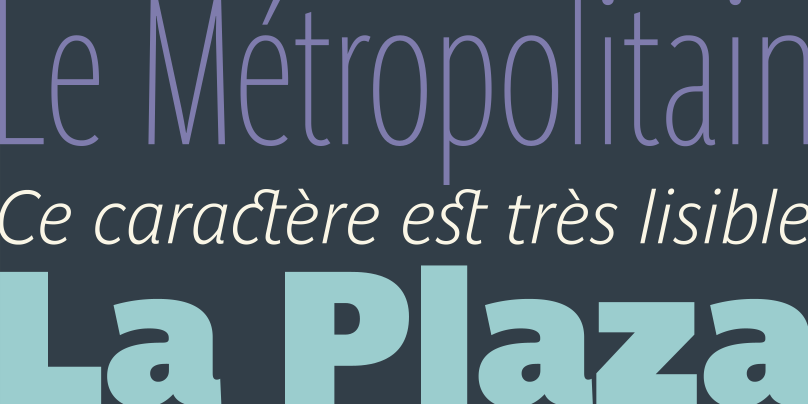
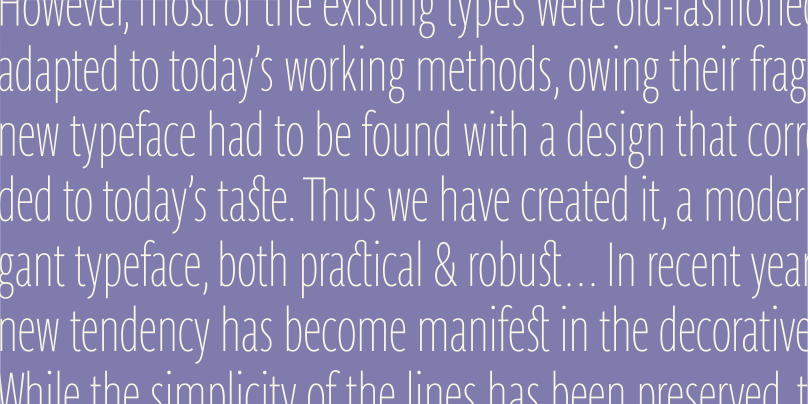
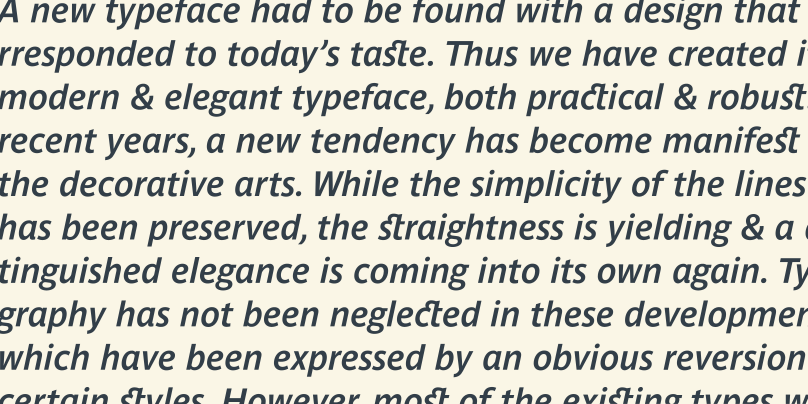
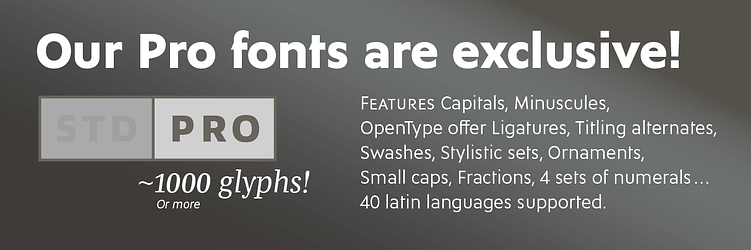
Expended into a large family along the years Parisine allows for the composition of numerous Latin-script European languages. Along with small caps available in all weights, 4 sets of figures are provided–lining and oldstyle–in tabular and proportional widths, depending on the version. Miniscule lowercase and figures for automated fractions, are also included. Another feature of Parisine is its alternate f ligatures. With the contextual alternates feature, a short top f will automatically replace the standard f in front of glyphs such as ì. The f ligatures of the original Parisine were designed disconnected to ensure perfect legibility in signage (and to be seen) where real traditionally-joined forms would not be suitable. The OpenType version of Parisine and its stylistic set 3 feature switches from these disconnected f ligatures to joined forms. The contextual feature replaces as well the sequence“word space-en dash-word space” by an en dash with surrounding fine spaces. Stylistic set 5 converts the connected c cedillas to disconnected c cedillas. Stylistic set 6 replaces caps ’A’ through ’H’ and lowercase ’a’ through ’h’ with multi-directional arrows.
Directly related, Parisine Office was initially created for Ratp’s internal and external communication, Parisine Office is available at Typofonderie too. Not connected with Ratp and public transports, Parisine Plus was created as an informal version of Parisine. Notable use of this typeface is the identity, signage of the Musée du Quai Branly in Paris.
PRO Open Type Features
Ligatures
Discretionary Ligatures
Small Caps
Case forms
Caps figures
Old Style Figures
Semi Oldstyle figures
Tabular Figures
Proportional Figures
Fractions
Numerators, Denominators
Ordinals/Superior Letters and figures
Contextual ligatures
Stylistic sets or Stylistic Alternates
Historical sorts
Pairs Well With
In Use
■ Available in STD Format